TEAM NAVER Proves Full-Stack AI Capabilities — From Models to Real-World Services — at ICML 2026, the World's Most Prestigious AI Conference
TEAM NAVER Proves Full-Stack AI Capabilities — From Models to Real-World Services — at ICML 2026, the World's Most Prestigious AI Conference
- Red-teaming research uncovering LLM vulnerabilities selected as a "Spotlight" paper, placing it in the top 2.2% of all accepted papers
- Company unveils SyMerge, FlowBot, and other technologies that dramatically improve the operational efficiency of AI models and agents
- "Seoul World Model," built on spatial data covering the entire city of Seoul, draws attention as core infrastructure for physical AI
July 13, 2026
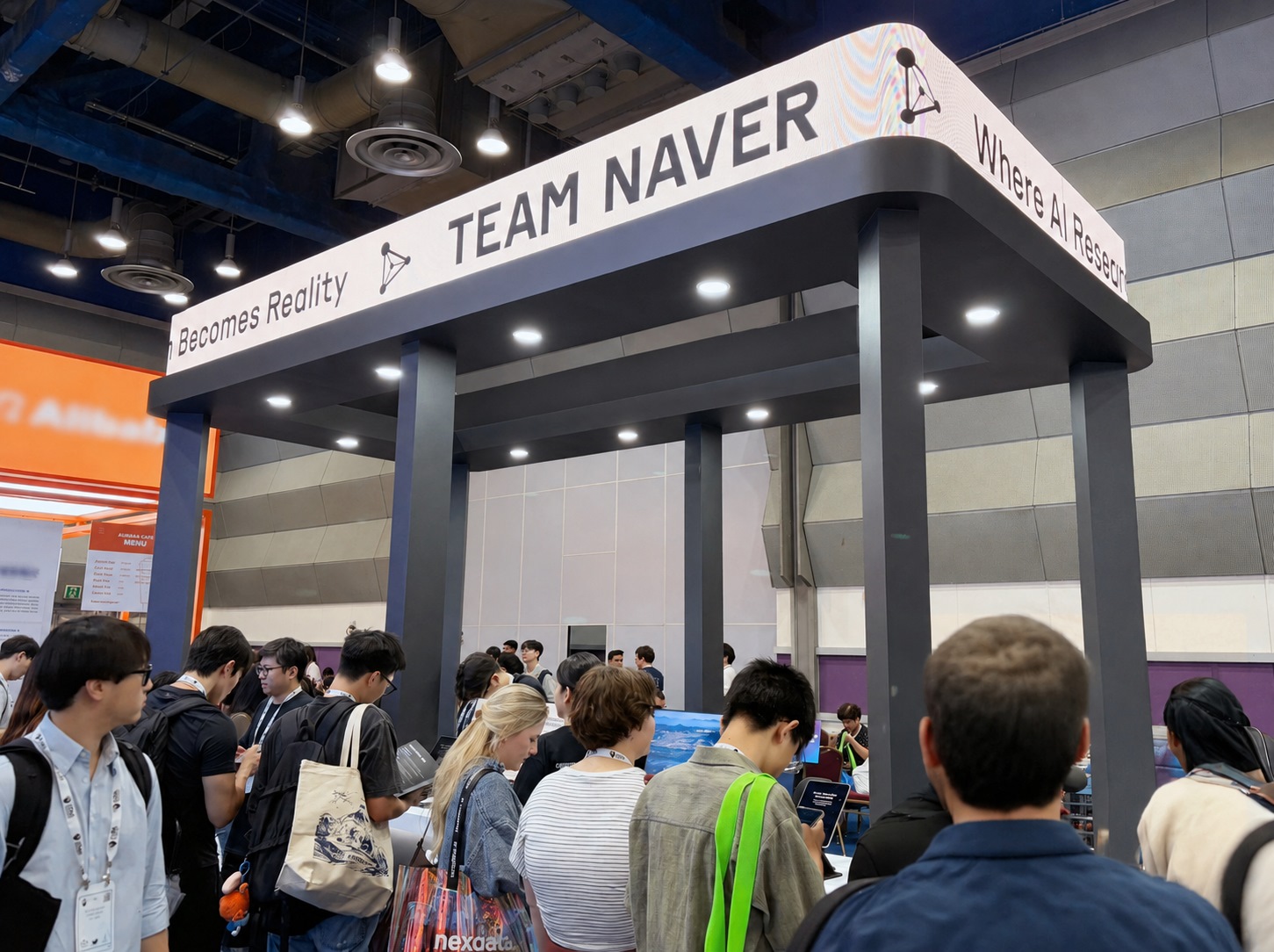
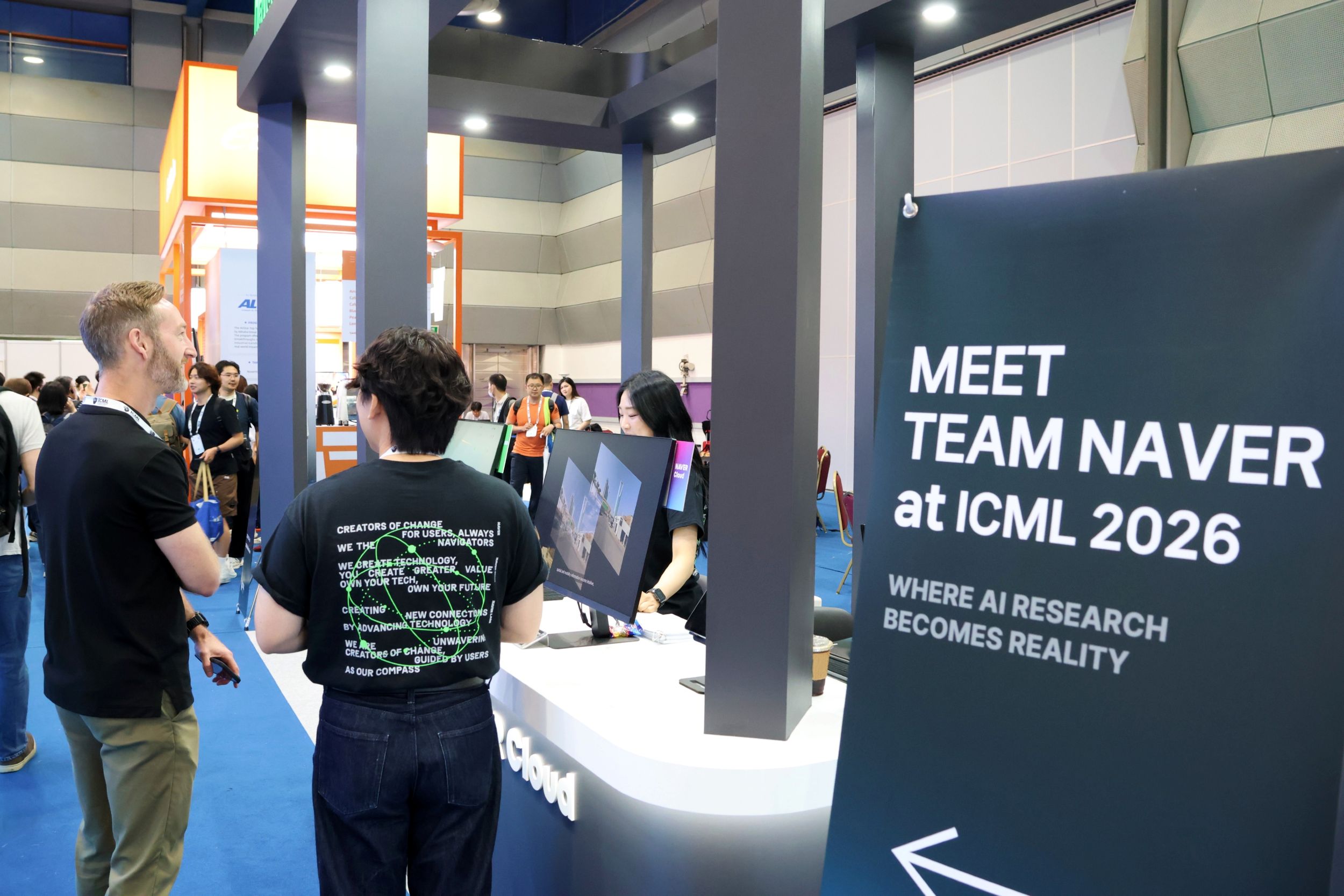
[Photo] TEAM NAVER participated in ICML 2026, a global AI conference, showcasing a wide range of AI technologies.
TEAM NAVER demonstrated its global AI competitiveness at ICML 2026 (International Conference on Machine Learning), one of the world's most prestigious AI conferences, presenting a broad range of research achievements spanning advanced AI models to physical AI in the real world.
Under the theme "Where AI Research Becomes Reality," TEAM NAVER participated in ICML 2026, held at COEX in Seoul from July 6 to 11, operating a booth that showcased not only key research achievements but also numerous real-world services built upon them.
The research presented by TEAM NAVER at this year's conference represents concrete progress toward applying full-stack AI technology to actual services and industrial sites, covering three major areas: strengthening AI safety, improving the operational efficiency of models and agents, and 3D spatial understanding with extension into the physical world.
The most notable research was a red-teaming technology that identifies LLM vulnerabilities from an attacker's perspective. Stable-GFlowNet, which structurally resolves the training instability and repetitive-pattern problems of existing approaches, was selected as a Spotlight paper — an honor reserved for roughly the top 2.2% of all accepted papers. The technology was recognized for enabling more robust verification of attack vulnerabilities across diverse scenarios before LLMs are deployed to live services.
In the area of model and agent operational efficiency, TEAM NAVER unveiled technologies for combining and operating AI more effectively. SyMerge is a model merging technique that integrates multiple models specialized for different tasks into one. Despite its remarkably simple premise — adjusting just a single layer to draw out synergy between models — it achieved state-of-the-art performance across a range of benchmarks spanning vision and natural language processing.
FlowBot is a technology that enables AI to autonomously determine the optimal sequence of tasks when multiple AI systems collaborate to solve a problem, eliminating the need for humans to design workflows manually — a result regarded as a core research achievement in harness engineering. TEAM NAVER also introduced a technique that groups hundreds to thousands of distinct datasets by their characteristics, trains them separately, and then boosts LLM post-training performance efficiently through a single merge.
In 3D spatial understanding, TEAM NAVER presented research on reconstructing dynamic three-dimensional scenes from a single camera's shaky or out-of-focus footage. While existing methods struggled to achieve precise reconstruction because motion caused an object's movement and shape information to become entangled, this research demonstrated outstanding reconstruction performance by estimating shape based on motion trajectories.
Alongside its paper presentations, TEAM NAVER spotlighted the Seoul World Model, a virtual recreation of the actual city of Seoul. Jointly developed by NAVER, NAVER LABS, KAIST (Korea Advanced Institute of Science and Technology), and Seoul National University, the model drew significant attention as a core platform for physical AI, simulating spatial data across all of Seoul for direct use in training robot navigation and behavior.
ICML (International Conference on Machine Learning) is regarded, alongside NeurIPS and ICLR, as one of the world's top three AI and machine learning conferences, and was held in Korea for the first time this year.
[Reference] TEAM NAVER's six papers accepted at ICML 2026
| SPOTLIGHT · TOP 2.2%
Stable-GFlowNet: Toward Diverse and Robust LLM Red-Teaming via Contrastive Trajectory Balance
| POSTER
SyMerge: From Non-Interference to Synergistic Merging via Single-Layer Adaptation
Kinematics-Driven Gaussian Shape Deformation for Blurry Monocular Dynamic Scenes
Decentralized Instruction Tuning: Conflict-Aware Splitting and Weight Merging
FLOWBOT: Inducing LLM Workflows with Bilevel Optimization and Textual Gradients
| POSITION TRACK
The Open Benchmark Paradox Must be Resolved through Sovereign Medical Evaluation